B-280 GF, Sushant Lok-III, Sector 57, Gurugram, HR 122011, IN
Appointments: 0124 429 4280

Appointments: 0124 429 4280

A damaged, weakened, or missing tooth affects far more than your appearance — it compromises your ability to bite, speak, and maintain the alignment of surrounding teeth. Dental crowns and fixed bridges are two of the most established and reliable restorations in modern dentistry, offering durable, natural-looking solutions that restore full function and aesthetics.
At Align Orthodontics, Sector 57, Gurugram, our team provides custom-fabricated crowns and bridges using high-quality materials — matched precisely to your natural teeth in shape, size, and shade.
A dental crown — often called a cap — is a custom-made restoration that fits over the entire visible portion of a tooth above the gum line. It restores the tooth to its original shape, size, and function while protecting it from further damage or fracture. Crowns are cemented permanently onto the prepared tooth and, with proper care, can last many years.
According to the American College of Prosthodontists, dental crowns are one of the most commonly performed restorative dental procedures worldwide, with clinical evidence supporting their long-term effectiveness in preserving compromised teeth that would otherwise require extraction.
A dental crown is the treatment of choice in several clinical situations. A tooth with a cavity too large
to be reliably restored with a filling alone — typically when more than half the tooth structure has
been lost — requires a crown for structural support. Any tooth that has undergone root canal treatment
becomes significantly more brittle and prone to fracture, and research published in the Journal of
Endodontics consistently demonstrates that crowning root-canal-treated posterior teeth dramatically improves their long-term survival. Fractured or cracked teeth that remain viable but structurally
compromised require a crown to hold the tooth together and prevent further splitting. Severely worn teeth
from grinding (bruxism) or acid erosion, discoloured or poorly shaped teeth that cannot be adequately corrected with veneers or bonding, and teeth used as anchors for a dental bridge all require crowns.

The choice of crown material depends on the tooth's location in the mouth, the biting force it must withstand, aesthetic requirements, and the amount of natural tooth structure remaining. At Align Orthodontics, we offer the following crown types.
Zirconia is currently the gold standard in dental crown materials. Zirconia crowns are exceptionally strong — strong enough for any position in the mouth including heavily loaded molar teeth — while being tooth-coloured and metal-free. They are biocompatible, meaning the gum tissue around them remains healthy, and they offer excellent long-term aesthetics. Monolithic zirconia crowns and layered zirconia crowns are both available depending on the aesthetic demands of the case.
All-ceramic crowns — typically fabricated from lithium disilicate glass ceramic such as IPS e.max — are
preferred for front teeth where maximum aesthetic translucency is required. They replicate the
light-transmitting properties of natural tooth enamel more closely than any other material. They are
metal-free, highly biocompatible, and extremely natural in appearance.
Porcelain-fused-to-metal crowns have a metal substructure for strength with a porcelain outer layer for aesthetics. They have a long and well-documented clinical track record. The limitation is a fine dark line that can become visible at the gum margin over time if the gum recedes — which
is why they have been largely superseded by zirconia and all-ceramic options for visible teeth in recent years. They remain a valid and cost-effective choice for posterior teeth in certain clinical situations.
Full metal crowns — gold or base metal alloy — are the most durable restorations available and require the least removal of tooth structure. They are exclusively used for posterior teeth where they are not visible. Gold crowns in particular have exceptional biocompatibility and a clinical longevity that no other material matches. They remain the treatment of choice in certain high-stress situations, particularly for patients with severe bruxism.
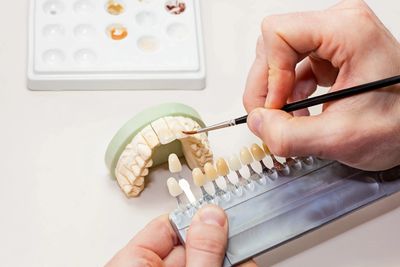
The tooth is prepared under local anaesthesia by reducing it by approximately 1 to 2 millimetres on
all surfaces to create space for the crown. The exact amount of reduction depends on the material chosen.
A precise impression of the prepared tooth and the adjacent and opposing teeth is taken and sent to
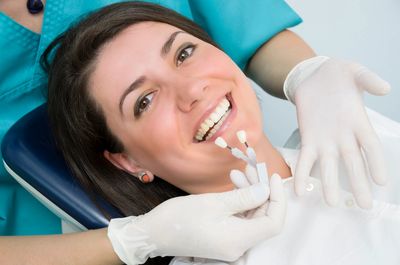
our dental laboratory. The shade of the crown is carefully selected against your natural teeth in natural lighting. A well-fitting temporary crown is placed to protect the tooth and maintain aesthetics and function during the fabrication period — typically seven to ten days.
The permanent crown is tried in to check the fit, the contacts with adjacent teeth, the bite, and
the aesthetics before cementation. Any adjustments required are made at this stage. Once all parameters
are satisfactory, the crown is permanently cemented with dental luting cement. A final occlusal check is performed to confirm the bite is balanced and comfortable.
A dental bridge is a fixed prosthetic restoration that replaces one or more missing teeth by spanning
the gap between the teeth on either side — the abutment teeth. The abutment teeth are prepared and
crowned, and the replacement tooth — called a pontic — is fused between them, forming a continuous,
fixed structure cemented in place.
Bridges are a well-established alternative to dental implants for patients who are not suitable implant
candidates, or for whom implant treatment is not preferred for clinical or personal reasons. The
Indian Dental Association recognises fixed bridgework as a clinically appropriate tooth replacement
modality when adequate abutment support is available and periodontal health is maintained.
A dental crown is the treatment of choice in several clinical situations. A tooth with a cavity too large
to be reliably restored with a filling alone — typically when more than half the tooth structure has
been lost — requires a crown for structural support. Any tooth that has undergone root canal treatment
becomes significantly more brittle and prone to fracture, and research published in the Journal of
Endodontics consistently demonstrates that crowning root-canal-treated posterior teeth dramatically
improves their long-term survival. Fractured or cracked teeth that remain viable but structurally
compromised require a crown to hold the tooth together and prevent further splitting. Severely worn teeth
from grinding (bruxism) or acid erosion, discoloured or poorly shaped teeth that cannot be adequately
corrected with veneers or bonding, and teeth used as anchors for a dental bridge all require crowns.
This is an important clinical consideration that patients are rarely told about. When a tooth is
extracted, the bone that previously supported its root begins to resorb — dissolve — progressively
over the months and years that follow. A dental bridge replaces the visible tooth and restores
function but does not prevent this underlying bone loss, because the pontic rests on the gum rather
than being anchored in the bone. Research published in the International Journal of Oral and
Maxillofacial Implants confirms that bone volume loss beneath bridge pontics is a predictable and
progressive finding over time.
A dental implant, by contrast, is anchored in the bone and actively stimulates it, preventing
resorption. This is an important factor when comparing bridge and implant treatment for younger
patients or those with a long life expectancy. Dr Sonia Sharma will discuss this in detail
at your consultation so you can make a fully informed decision.