B-280 GF, Sushant Lok-III, Sector 57, Gurugram, HR 122011, IN
Appointments: 0124 429 4280

Appointments: 0124 429 4280

Align Orthodontics, Sector 57, Gurugram offers reliable, painless root canal treatment performed by experienced dental specialists. Using advanced rotary endodontics and digital X-ray technology, most root canal procedures at our Gurugram clinic are completed in a single sitting. We treat infected, damaged, and previously failed root canals — with a focus on saving your natural tooth wherever possible.
What is a Root Canal Treatment?
Root canal treatment — often called RCT or endodontic treatment — is one of the most frequently misunderstood dental procedures.
Far from being the painful ordeal of popular perception, modern root canal treatment performed under effective local anaesthesia is a comfortable, tooth-saving procedure that relieves pain rather than causes it.
At Align Orthodontics, our dental team uses the latest endodontic techniques and
materials to ensure your treatment is efficient, comfortable, and delivers a lasting result.
According to the American Association of Endodontists, more than 15 million root canal treatments are performed worldwide each year, with a clinical success rate exceeding 85 to 95 percent when performed by trained practitioners using modern techniques.
Root canal treatment is indicated when the tooth pulp has become
irreversibly inflamed or infected. Common signs include severe,
spontaneous toothache or pain that lingers after hot or cold
stimulation. Tenderness when biting or touching the tooth and
swelling of the gum or face near the affected tooth are also
warning signs. Discolouration of the tooth, a persistent pimple
or sinus tract on the gum near the tooth, and a tooth that was
previously treated and has re-infected all indicate the need
for treatment. Importantly, some teeth with dead pulps cause
no pain at all — which is why regular dental X-rays are
essential for early detection, as recommended by the Indian
Dental Association in their national oral health guidelines.
To understand root canal treatment, it helps to understand the anatomy of a tooth. Each tooth has
The pulp contains the nerve fibres, blood vessels, and connective tissue that nourished the tooth during its
development. It runs through the length of the tooth in narrow channels called root canals, exiting at the tip of each root.
When a cavity, crack, or traumatic injury penetrates deep enough to reach the pulp, bacteria enter and cause inflammation or infection — a condition called pulpitis.
The pulp has no mechanism to fight this infection effectively, and without treatment the infection spreads through the root canals into the surrounding bone, forming a dental abscess. Root canal treatment removes the infected pulp, disinfects the canal system, and seals it permanently — saving the tooth.
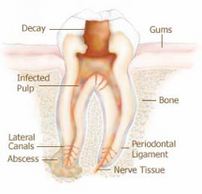
Accurate diagnosis is the foundation of successful root canal treatment.
At Align Orthodontics, diagnosis involves a thorough clinical examination, digital X-rays, and in complex cases, a cone beam CT scan to visualise the full three-dimensional anatomy of the root canal system.
An electronic apex locator is used during treatment to determine the precise working
length of each canal — a critical factor in complete debridement and sealing.
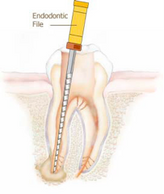
Treatment is performed under local anaesthesia — the area is completely numb before any instrumentation begins.
An access cavity is created through the biting surface of the tooth, giving the clinician a direct path to the canal system.
Using rotary nickel-titanium files, the canals are shaped and cleaned to a smooth, tapered finish while irrigating continuously with sodium hypochlorite solution to eliminate bacteria.
At Align Orthodontics, we use the Crown-Down technique — an approach endorsed by the European Society of Endodontology
— which progressively shapes the canal from the upper portion downward, improving disinfection effectiveness and reducing the risk of file separation.
Thorough disinfection is the most critical stage of root canal treatment. Irrigation with sodium hypochlorite eliminates bacteria within the main canal, while ultrasonic activation
of the irrigant improves penetration into lateral canals and accessory spaces.
A medicated intracanal dressing of calcium
hydroxide may be placed between appointments in cases of active infection.

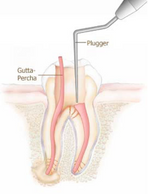
Once the canals are fully cleaned, shaped, and dried, they are filled permanently — a process called obturation.
At Align Orthodontics, we use warm vertical compaction of Gutta-percha with AH Plus resin-based sealer or Bio-ceramic sealer— a technique that achieves a dense, three-dimensional filling of the entire canal space, including lateral canals and irregularities.
AH Plus is recognised in endodontic literature as one of the most biocompatible and dimensionally stable root canal sealers available.
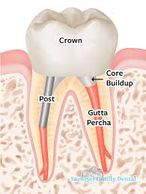
The final and equally important stage is sealing the access cavity with a high-quality coronal restoration.
A tooth that has undergone root canal treatment has lost much of its internal structure and becomes more brittle over time.
Research published in the Journal of Endodontics consistently demonstrates that teeth restored with full-coverage crowns after root canal treatment have significantly higher long-term
survival rates than those restored with fillings alone.
At Align Orthodontics, crown placement after RCT is strongly recommended for all posterior teeth.
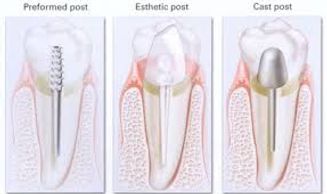
Post and Core is done to assist the filling if the tooth is grossly damaged & is weak at the neck.
A metal or fiber glass post is inserted in the prepared Root Canal to gain strength from the tooth Root. It is then cemented and the filling is done. The tooth is later prepared for the crown/cap.

Contrary to outdated practice, root canal treatment can often be completed in a single visit for suitable cases. Single-visit RCT is appropriate for teeth with vital — living — pulp tissue, teeth with straightforward canal anatomy, and cases with no active periapical infection or swelling.
Multi-visit treatment is preferred for teeth with active abscesses, complex curved or calcified canals, retreatment cases where a previous filling must be removed, and cases where a calcium hydroxide dressing between visits is clinically indicated.
The decision is always made on clinical grounds — not convenience or scheduling. A review of
randomised controlled trials in the International Endodontic Journal found no statistically significant difference in outcome between single-visit and multi-visit treatment when cases are selected correctly.
Some tenderness on biting is normal for the first few days after root canal treatment, particularly if there was pre-existing infection. This responds well to standard analgesics such as ibuprofen or paracetamol and typically resolves within three to five days. Severe or worsening pain, visible swelling, or fever after treatment should be reported to the clinic immediately.
The tooth should be protected from heavy biting forces until the permanent crown is placed. Once crowned, a well-treated and properly restored tooth can function normally for many years — in many cases, for a lifetime.
No. Root canal treatment is performed under local anaesthesia and should be no more uncomfortable than having a filling placed.
The procedure relieves the severe pain caused by pulpal infection — it does not cause it. The historical
association of root canal treatment with pain stems from older techniques and inadequate anaesthesia.
Modern endodontic practice is a comfortable, well-tolerated procedure for the vast majority of patients.
A straightforward root canal treatment at Align Orthodontics typically requires two to three clinical visits — one for canal preparation and cleaning, one for obturation, and one for the final crown preparation. Complex cases or those with active infection may require additional appointments.
Your treating dentist will outline the expected number of visits at your first consultation.
Yes, though this is uncommon when treatment is performed thoroughly.
Re-infection can occur if the coronal seal fails
— for example if a temporary filling is left in place
too long without a permanent restoration
— or if missed canals were not treated at the initial appointment.
— or multiple number of accessory canals which can't be sealed completely.
Retreatment of a previously root-filled tooth is a specialist procedure that is available at Align Orthodontics wherever clinically appropriate.
In the vast majority of cases, saving a natural tooth through root canal treatment is preferable to extraction. Natural teeth provide better chewing function, maintain the jawbone, and preserve the spacing and alignment of adjacent teeth.
The Indian Dental Association advocates tooth preservation as the primary goal of dental treatment wherever clinically feasible.
Extraction should only be recommended when root canal treatment is not technically possible or when the
surrounding bone support is insufficient to justify saving the tooth.